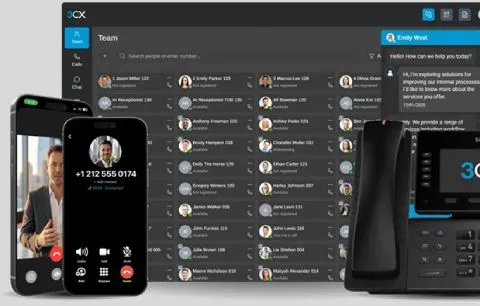
VoIP telephony allows companies to make phone calls over the Internet instead of using traditional landlines. For many organizations, this means not only lower costs but also greater flexibility, improved customer service, and easier business scalability. So how exactly does VoIP work in a company, and is it a technology worth implementing today?
What is VoIP and How Does It Work in a Company?
VoIP (Voice over IP) transmits voice as data over the Internet. When an employee makes a call, their voice is digitally encoded, split into packets, and sent over the Internet to the recipient, where it is converted back into sound.
In practice, VoIP works very similarly to traditional telephony – employees make and receive calls – but the system’s “logic” is handled by a VoIP PBX. This can operate locally or in the cloud and manages call routing, queues, announcements, and call recording. As a result, internet telephony becomes a full-fledged business tool rather than just a replacement for a landline.
Key Differences Between VoIP and Traditional Landline Telephony
The main differences between VoIP and traditional telephony are costs and flexibility. Traditional phone systems require separate infrastructure, physical lines, and often long-term contracts. Any change – a new number or an additional workstation – involves extra costs and paperwork.
VoIP operates on the existing network infrastructure. Numbers are assigned to users, not desks, allowing employees to use their company number both in the office and remotely without affecting call quality. For many companies, this mobility and scalability are VoIP’s main advantages.
Technical Requirements for Implementing VoIP
One common myth about VoIP is that it requires advanced IT infrastructure. In reality, the basic requirement is a stable Internet connection with sufficient bandwidth.
A well-designed network – including a router with traffic prioritization and proper local network configuration – directly affects call quality. In most modern offices, implementing VoIP requires minimal changes, often just activating the service and connecting IP phones or applications.
VoIP Costs in a Company and What Determines Them
Cost is one of the main reasons companies switch to VoIP. Unlike traditional landlines, the billing model is flexible and scalable according to business size. The total cost typically includes:
subscription fees,
the number of users,
VoIP call rates.
Many companies notice real savings within the first few months, especially with a high volume of external or international calls.
Benefits of VoIP for Companies – Savings, Flexibility, and Scalability
VoIP benefits go beyond cost reduction. This technology allows companies to respond quickly to changes – team growth, seasonal call spikes, or remote work transitions.
VoIP scalability enables adding new users and features without investing in hardware. Companies also gain access to tools like call queues, IVR, and CRM integrations, which significantly improve customer service.
Is VoIP Secure and Suitable for Every Company?
Modern VoIP systems use advanced security mechanisms, including call encryption and access control. With proper configuration, the system is secure and stable.
VoIP is ideal for companies that rely on the Internet as a primary work tool. In areas with very unstable connections, additional solutions may be needed, but in most cases, it is fully ready for business use..
FAQ – Frequently Asked Questions About VoIP
How does VoIP work in a company without an office?
Employees use applications or IP phones, while the VoIP PBX operates in the cloud.
Does VoIP require a PBX?
Yes, usually a cloud-based VoIP PBX is used, without the need for physical installation.
Does VoIP call quality match traditional landlines?
With a stable Internet connection, call quality is very high.
How quickly can VoIP be implemented?
In many cases, setup takes one to a few days.